
M6 Brass Inserts
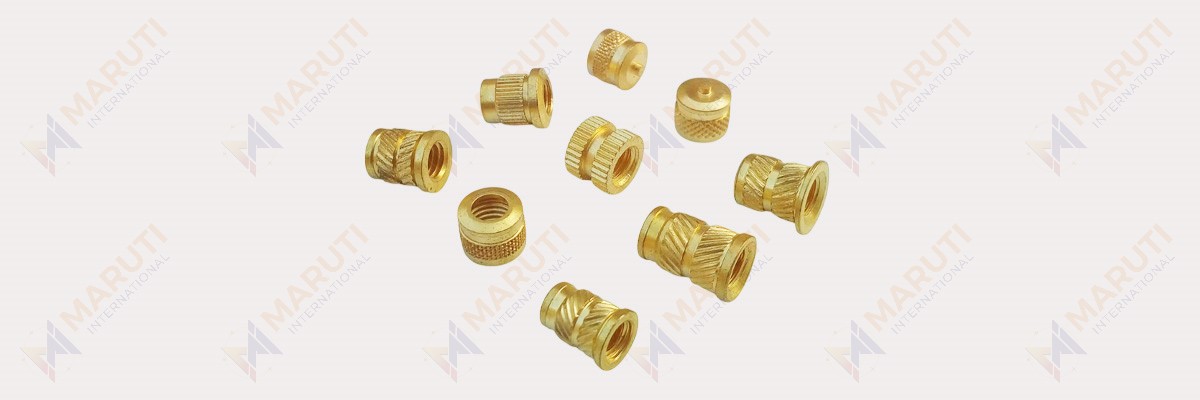
M6 Brass Inserts: The Heavy-Duty Standard for 2026 Manufacturing
In the high-stakes world of industrial assembly, the M6 brass insert stands as a critical component for bridging the gap between soft materials and heavy-duty fastening. While smaller inserts handle light electronics, the M6 (6mm) profile is the go-to solution for structural stability in automotive, furniture, and heavy machinery sectors.
At Maruti International, located in Jamnagar, Gujarat, we engineer M6 brass inserts that meet the exacting standards of Industry 4.0. This guide covers everything you need to know about integrating these robust fasteners into your 2026 production line.
What Are M6 Brass Inserts?
An M6 brass insert is a cylindrical fastener with an internal metric thread of 6mm diameter. Unlike smaller counterparts (like M3 or M4), M6 inserts are designed to bear significant axial loads and torque. They are typically embedded into plastics, wood, or composites to provide a durable, wear-resistant metal thread that won't strip under pressure.
Technical Snapshot (Standard Specs)
- Thread Size: M6 (Metric 6mm).
- Material: High-grade Brass (e.g., CuZn37, CuZn39Pb3) for optimal thermal conductivity and machinability.
- Design: Features deep knurling (diamond or straight) to maximize pull-out resistance and torque retention.
Why M6 Inserts Are Critical in 2026
As industries push for "Right-to-Repair" and sustainable modular designs, permanent bonding methods (like glues) are being replaced by reusable threaded connections:
- 1. High Load-Bearing Capacity: M6 inserts provide the structural integrity needed for parts that face constant vibration or mechanical stress. The brass composition absorbs shock better than harder metals, protecting the surrounding plastic from cracking.
- 2. Superior Thermal Performance: Brass is approximately 15 times more thermally conductive than stainless steel. This property makes M6 inserts ideal for heat-set installation, where the insert must heat up and cool down rapidly to lock into thermoplastics without slowing down the assembly line.
- 3. Corrosion Resistance For Harsh Environments: Whether used in marine equipment or outdoor furniture, our brass inserts resist oxidation naturally. This eliminates the need for expensive plating and ensures the thread remains usable even after years of exposure.
Primary Applications for M6 Inserts:
Due to their larger diameter and strength, M6 inserts from Maruti International are favored in:
- Automotive Assembly: Securing intake manifolds, interior consoles, and engine covers where vibration resistance is non-negotiable.
- Modern Furniture: Providing robust, invisible joinery for flat-pack furniture, allowing customers to assemble and disassemble items without stripping the wood holes.
- Industrial Enclosures: Fastening heavy lids and panels on electrical distribution boxes and machinery housings.
- 3D Printed Prototypes: Essential for functional parts printed in ABS or Nylon that need to test real-world mechanical loads.
Installation Methods
To ensure maximum performance, choose the method that suits your production volume:
- 1. Heat Staking (Thermoplastics): The most common method for high-volume production. The insert is heated and pressed into a pre-molded hole, where the plastic reflows around the knurls for a solid bond.
- 2. Ultrasonic Insertion: Uses high-frequency vibration to create frictional heat. This is fast and clean, ideal for automated electronics assembly lines.
- 3. Mold-In: The insert is placed into the mold cavity before plastic injection, offering the highest possible pull-out strength.
Why Partner with Maruti International?
Based in Jamnagar, the brass component capital of the world, Maruti International combines traditional craftsmanship with modern CNC precision.
- Customization: We offer M6 inserts in varying lengths (e.g., 8mm, 10mm, 12mm) and knurling patterns to match your specific torque requirements.
- Zero-Defect Quality: Our ISO-certified processes ensure every thread meets international "Go & Not Go" gauge standards.
- Global Reach: We export precision components worldwide, ensuring your supply chain remains robust regardless of your location.
Conclusion:
In 2026, the difference between a premium product and a faulty one often comes down to the smallest details. M6 brass inserts provide the anchoring strength your products need to survive the rigors of real-world use. Don't compromise on connection quality. Contact Maruti International today to request a quote or discuss custom M6 solutions for your next project.
FAQ:
1. What is the recommended hole size for an M6 heat-set insert?
The hole size depends on the insert's outer diameter (OD). Typically, for an M6 insert with an OD of ~8mm, a hole size of roughly 7.6mm–7.8mm is recommended to allow plastic to reflow around the knurls. Always check the specific datasheet for your batch.
2. Can M6 brass inserts be used in wood?
Yes. For wood applications, we recommend "screw-in" or "press-in" variants with external knife threads designed to slice into the timber, rather than standard knurled heat-set inserts used for plastic.
3. Why choose brass over steel for M6 inserts?
Brass is easier to machine (lowering costs), transfers heat faster for installation, and won't rust. Steel is harder but more expensive and slower to install via heat methods.
4. Does Maruti International offer blind vs. through-hole M6 inserts?
Yes, we manufacture both. Blind inserts (closed bottom) are excellent for preventing glue or plastic from entering the thread during installation.